K3s High Availability Cluster Design
This document describes the core architecture of my bare-metal homelab Kubernetes cluster. The cluster uses K3s, as decided in ADR-001.
You can find the automated setup and code used to build this setup in my repository: rpi-k3s-cluster-image-builder.
High Availability (HA) is the main goal. If a machine loses power or hardware fails, the control plane must keep running automatically without any manual fixing.
K3s Architecture Explained
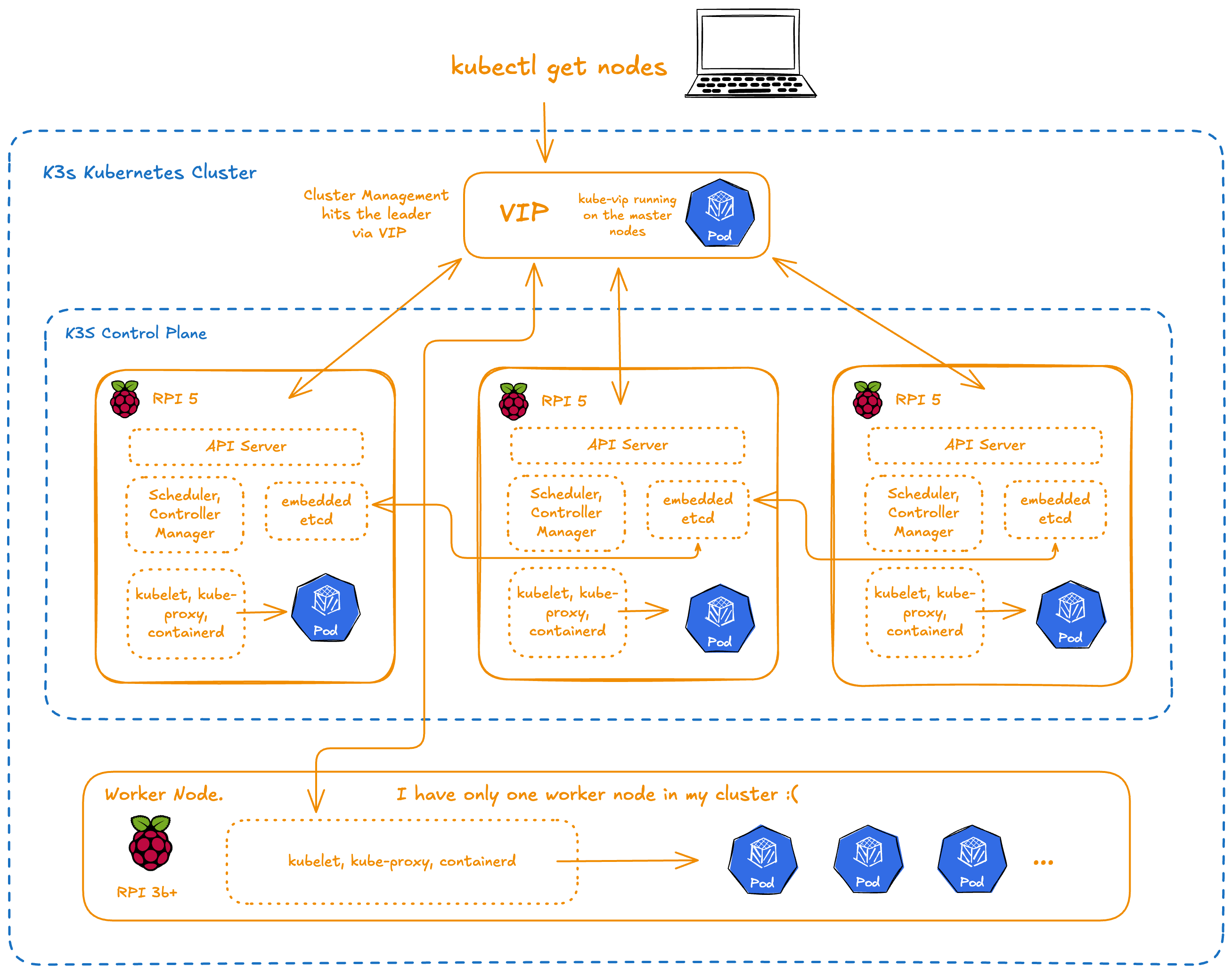
This diagram illustrates the complete data flow and component structure of the HA K3s homelab cluster. The system is designed so that no single hardware failure will bring down the control plane.
The Virtual IP (VIP) Entry Point
At the very top, all cluster management commands (such as running kubectl get nodes from a laptop)
are sent to a single VIP. This VIP is managed by kube-vip, which runs as a Pod on all three master
nodes. Kube-vip continuously monitors the cluster, elects a "Leader" master node, and directs all
incoming management traffic strictly to that active leader.
The Control Plane
The middle section shows the K3s Control Plane, powered by three Raspberry Pi 5 nodes. Each node runs a bundled set of K3s services (all out of single-binary):
- API Server, Scheduler, and Controller Manager: The core logic of the cluster.
- Embedded etcd: The database that stores the cluster's state. The horizontal arrows connecting the embedded etcd blocks represent the Raft consensus algorithm. These three databases continuously talk to each other to synchronize their data. If one node dies, the other two still hold a perfect copy of the cluster state.
- Worker Components: Unlike standard Kubernetes, the K3s masters also run kubelet, kube-proxy, and containerd. This allows the Raspberry Pi 5 nodes to host standard application Pods (shown as blue hexagons) alongside the control plane, maximizing hardware usage.
The Worker Node
At the bottom is the dedicated Worker Node (my old Raspberry Pi 3B+). Notice that the connection line from the worker node points up to the VIP, not to a specific master node. This is a critical HA feature: if the leader master node loses power, the VIP automatically moves to a surviving master, and the worker node seamlessly stays connected to the cluster. The worker node is stripped down to only run worker services, providing dedicated compute power for application Pods.
Official K3s Documentation
For deeper technical specifications regarding the single-binary design, embedded etcd, and networking, refer to the official K3s Architecture documentation. This overview also doesn’t cover all services (for example, Flannel), so please refer to the official docs for details.
VIP via kube-vip
To provide a single, highly available point of contact across three separate master nodes, VIP is established using kube-vip.
Because there are three physical master nodes, there are three different physical IP addresses.
Kube-vip creates a single, floating IP address that external clients (like your laptop's kubectl)
and internal worker nodes use to talk to the cluster.
# Conceptual deployment mechanism
apiVersion: apps/v1
kind: DaemonSet
metadata:
  name: kube-vip-ds
  namespace: kube-system
# ... configured to bind to hostNetwork and elect a leader
The theoretical routing and failover behavior operates using these mechanisms:
-
DaemonSet Deployment: Exactly one pod is executed on every master node. By placing the configuration file in the K3s manifests directory, K3s automatically deploys kube-vip before the cluster is even fully booted.
-
Leader Election via Leases: All three kube-vip pods are active, but they hold an election using the Kubernetes Lease API (stored in the embedded etcd database). The first pod to grab the lease becomes the "Leader." The other two pods become "Standbys" and constantly monitor this lease.
-
Layer 2 Networking (ARP): Kube-vip in this architecture operates in Layer 2 mode. The winning Leader binds the VIP to its physical network interface. It then sends a broadcast message to the homelab router saying, "Send all traffic for the VIP to my specific MAC address." All cluster management traffic is now processed by this Leader's API server.
-
Instant Failover (Gratuitous ARP): If the Leader node loses power, it stops renewing its lease. Within seconds, the lease expires. The surviving standby pods detect this, and a new leader grabs the lease. The new leader instantly broadcasts a Gratuitous ARP message to the network switch. This tells the switch, "The VIP has moved; update your tables and send the traffic to my MAC address now." Traffic is rerouted instantly, keeping the control plane online.